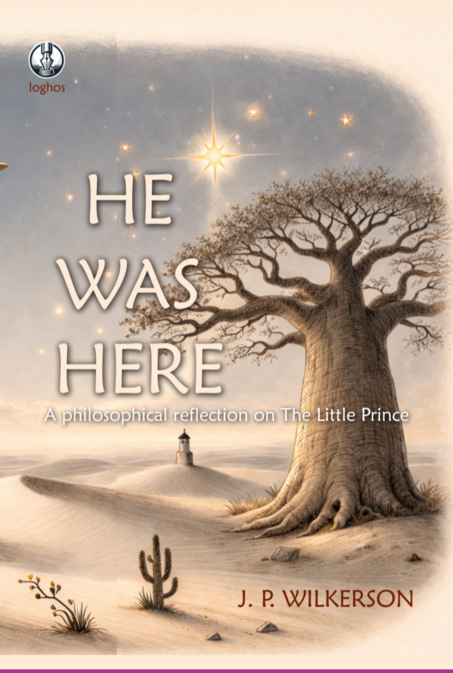
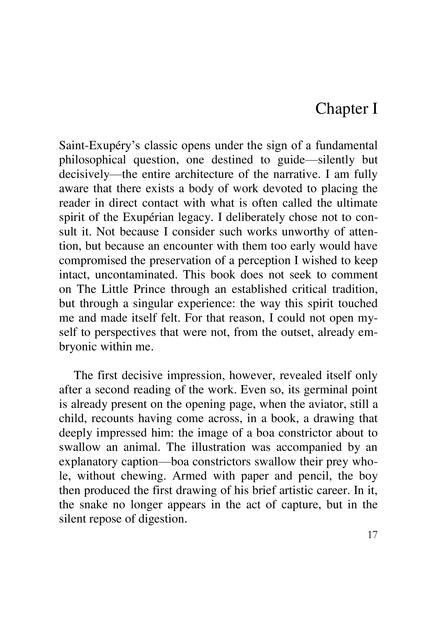
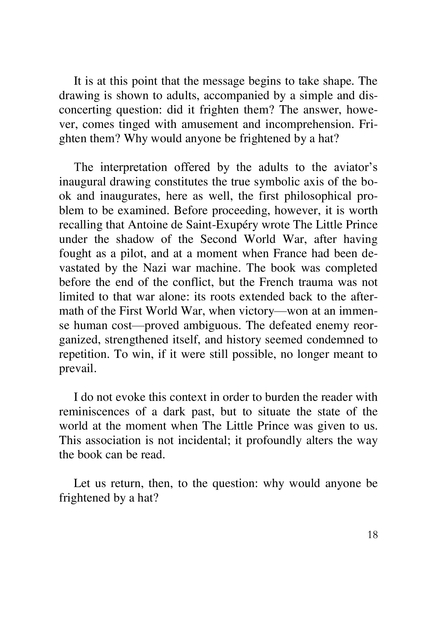
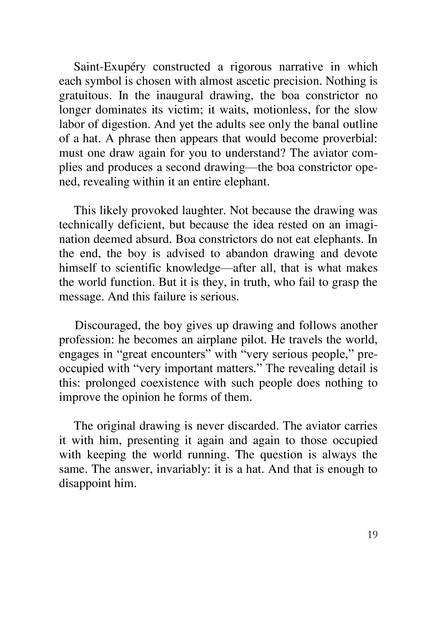
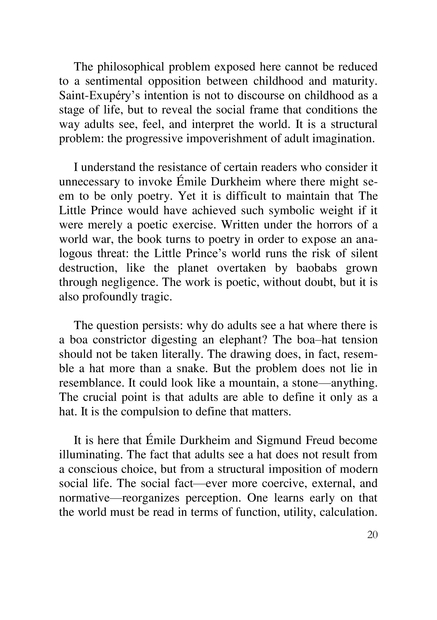
This book is not a retelling of The Little Prince.
It is an existential and ethical reading of what the original story leaves unresolved: the cost of leaving, the asymmetry between the one who departs and the one who remains, and the kind of guilt that does not arise from error, but from freedom.
Following the Little Prince’s journey from planet to planet, through the desert and toward his return, the author shifts the interpretative focus. Rather than presenting the voyage as a simple narrative of maturation, the book examines it as a moral traversal marked by loss, responsibility, and irreconcilable choices. Each encounter — the drunkard, the businessman, the lamplighter, the geographer, the fox, and the aviator — is read not as allegory or moral lesson, but as a confrontation with different ways of avoiding or sustaining human vulnerability.
Drawing on psychoanalysis and existential philosophy, the text engages Freud, Winnicott, Sartre, Camus, and Kierkegaard not as theoretical frameworks imposed from outside, but as interpretive companions. Their ideas serve one central question: what does it mean to love when permanence, reciprocity, and redemption cannot be guaranteed?
At the center of the book stands the rose. Not as a metaphor of fragility alone, but as a figure of ethical endurance. While most readings emphasize the Little Prince’s learning process, this work restores narrative and moral weight to the one who stays behind. The rose does not travel, does not explai
| ISBN | 9786501966724 |
| Número de páginas | 144 |
| Edição | 1 (2026) |
| Formato | A5 (148x210) |
| Acabamento | Brochura c/ orelha |
| Coloração | Preto e branco |
| Tipo de papel | Ahuesado 80g |
| Idioma | Inglês |
Tem algo a reclamar sobre este livro? Envie um email para [email protected]






Faça o login deixe o seu comentário sobre o livro.